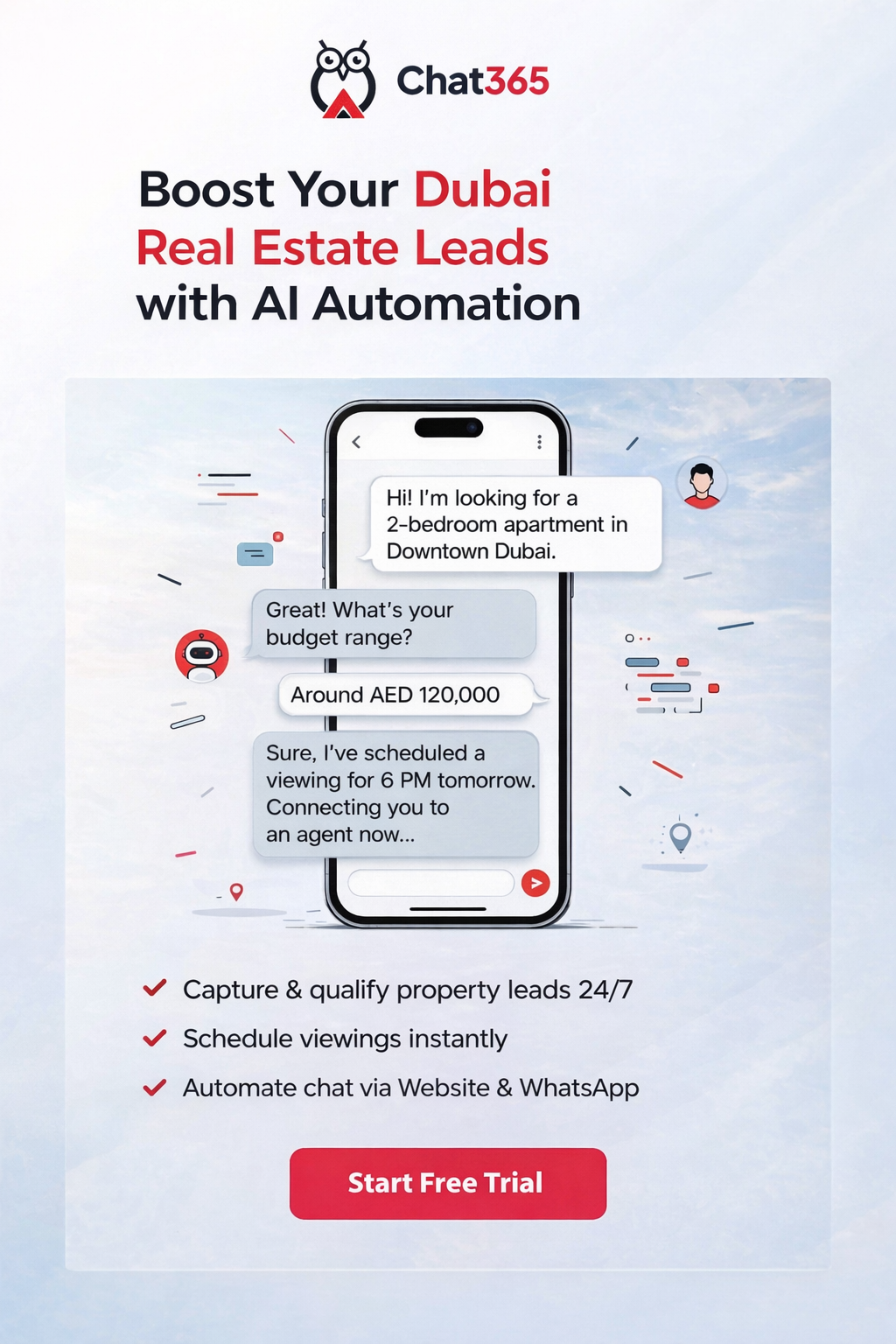
What Real Estate AI Automation Actually Means in Practice
For many real estate businesses in Dubai, AI automation sounds abstract until it is translated into daily operations. In practical terms, it means using an intelligent assistant across website chat and WhatsApp to handle the first layer of customer communication automatically. Instead of letting every inquiry sit in a shared inbox until an agent becomes available, the system can answer common questions, ask follow-up questions, collect lead details, recommend relevant listings, and coordinate the next step.
That next step might be scheduling a viewing, routing a rental lead to the leasing team, collecting investor intent, or handing a serious buyer to a broker with all context already captured. The real value is not that AI replaces the relationship-driven side of real estate. It is that it removes the slow, repetitive, manual work that causes leads to cool off before an agent even has a chance to engage.
In Dubai, where property conversations can begin through website forms, portal traffic, social campaigns, and WhatsApp messages at any hour, this kind of automation creates a much more responsive business model. It allows teams to treat speed as a system, not as a matter of luck or individual availability.
Why Response Speed Matters So Much in Dubai Property Sales and Rentals
In many markets, delayed follow-up is inconvenient. In Dubai real estate, it is expensive. Buyers comparing communities such as Downtown, Business Bay, Dubai Hills, JVC, or Palm Jumeirah are rarely speaking to only one broker. Tenants looking for family apartments or short-term furnished options often send multiple inquiries in a short period of time. Investors reviewing yield potential or payment plans may lose interest quickly if the initial response feels generic or delayed.
This creates a simple but powerful truth: response speed shapes perceived professionalism. A fast, structured first reply signals that the business is active, organized, and ready to help. A late response signals the opposite, even if the actual team behind it is highly experienced. In a market built on momentum, small delays can break intent.
AI chatbot automation for real estate helps close that gap. When a lead arrives, the business no longer has to choose between ignoring it until business hours or relying on rushed manual replies. The conversation can begin immediately. Basic questions can be answered instantly. Important qualifying details can be collected before a human agent joins. That alone can reduce lead leakage dramatically, especially during evenings, weekends, and campaign-driven spikes in inquiry volume.
Improving Buyer and Tenant Communication Without Adding Friction
One of the biggest pain points in real estate is that many inquiries are genuine, but incomplete. A buyer may ask if a unit is available without mentioning budget. A tenant may ask for details on a property but omit move-in timing. An investor may request information but provide very little context about what type of asset they are actually considering. Agents then have to spend time repeating the same initial questions before they can give a meaningful answer.
Automation improves this by making the first exchange more structured and more useful. Instead of a flat contact form or a delayed callback, the conversation becomes interactive from the beginning. A prospective tenant can be asked about preferred location, move-in date, furnishing preference, and budget. A buyer can be asked whether they are searching for end use or investment, what property type they prefer, and whether financing is involved. This does not make the interaction feel robotic when done properly. It makes it feel efficient.
For property management companies, the same principle applies on the tenant side. Routine questions about maintenance updates, lease renewal timing, document requirements, or community rules can be handled much faster through automated conversations. That reduces the communication burden on internal staff while giving residents a more immediate service experience.
In Dubai, multilingual communication also matters. Property businesses often deal with local clients, expats, regional investors, and international buyers in the same funnel. Supporting Arabic and English naturally across these conversations is not just a convenience. It improves trust and reduces friction at the earliest stage of engagement.
How AI Helps Qualify Leads Before Passing Them to Agents
Not every inquiry deserves the same level of urgency, but every inquiry deserves a response. This is where AI automation becomes especially useful for brokers and developers. It can act as the first filter without becoming a dead end.
A serious buyer asking about a two-bedroom apartment in Dubai Marina with a clear budget and a request for a viewing tomorrow should not sit in the same queue as a vague inquiry with no timeline and no stated intent. A developer launching a project in Dubai South or Arjan may receive hundreds of messages after a campaign goes live, but only a portion of those contacts will be ready for immediate follow-up. When teams have to sort all of that manually, response quality drops and opportunities are missed.
With automation in place, the business can collect the details that matter most before the conversation is escalated. Budget, property type, preferred area, financing status, move-in timeline, purchase purpose, and branch or agent preference can all be captured in a structured way. By the time the conversation reaches a human advisor, the lead is more organized, easier to prioritize, and far more actionable.
This improves conversion in two ways. First, serious leads reach the team faster. Second, agents spend less time on repetitive qualification and more time on actual sales conversations. In a market like Dubai, where competition and ad spend can both be high, that efficiency has direct commercial value.
Website and WhatsApp Automation for Real Estate Businesses
Real estate communication in Dubai does not happen in one place. Some prospects discover properties on a website and want immediate details. Others prefer sending a quick WhatsApp message because it feels more direct. Many start on one channel and continue on another. That fragmented journey creates handoff problems when businesses are not set up to manage conversations centrally.
This is one of the strongest reasons automation has become so important. Website chat and WhatsApp are not competing channels; they are part of the same customer journey. A lead who sees a listing at night may ask a question on the site, continue the conversation later on mobile, and then expect a viewing confirmation without repeating everything again.
When those channels are automated properly, the business can maintain continuity. Listing questions, rental inquiries, community details, availability checks, and follow-up prompts can all happen in a consistent flow. More importantly, when a human needs to step in, they step into an informed conversation rather than a blank thread.
That matters for agency teams, developer sales centers, and property managers alike. It reduces missed context, cuts down manual copy-paste between systems, and helps create a smoother experience for the customer. In a city where mobile communication is dominant, especially through WhatsApp, that kind of continuity is increasingly expected.
How Chat365 Supports Real Estate Teams in Dubai
Chat365 is designed to support the actual rhythm of high-intent customer conversations. For real estate teams in Dubai, that means more than answering a few simple FAQs. It means helping businesses capture inquiry volume, organize it intelligently, and route it efficiently without losing the human touch that property transactions still require.
With Chat365, a real estate business can automate website and WhatsApp conversations using workflows that reflect how the market actually operates. A buyer can ask about a property, receive immediate responses, be guided through qualification, and then be handed to an agent with context intact. A tenant can ask about lease availability or viewing timing and get an answer without waiting for office hours. A developer can use the same system to manage campaign-driven inquiry spikes more smoothly and ensure that high-intent prospects are not buried under unstructured messages.
The platform also helps centralize conversation handling. Instead of spreading inquiries across disconnected devices, inboxes, and staff members, teams can work from a more organized communication layer. That is especially valuable for businesses managing multiple projects, communities, or service categories at the same time.
Consider a realistic example. A prospect sends a late-evening WhatsApp message asking about a two-bedroom apartment in Dubai Marina. Instead of waiting until the next morning, Chat365 responds immediately, asks about budget and move-in preference, confirms whether the inquiry is for rental or purchase, and suggests matching options. The prospect chooses a preferred slot for a viewing. By the time an agent opens the thread, the conversation is already structured, the need is clear, and the next action is obvious. What would normally take several rounds of manual follow-up has already been completed in minutes.
The Future of AI in Dubai Real Estate
Dubai's property market will continue to become more digital, but the real shift is not just about where leads come from. It is about how quickly businesses can respond, how consistently they can qualify interest, and how efficiently teams can move from inquiry to action. AI automation sits directly in that transition.
Over time, the businesses that use automation well will not simply look faster. They will operate differently. They will have cleaner lead funnels, more structured conversations, better visibility across channels, and less dependence on constant manual follow-up. Agents will still play the decisive role in negotiations, tours, and trust-building, but they will do that work with better prepared leads and far less administrative drag.
For developers, agencies, and property management companies in Dubai, this is becoming a strategic advantage rather than a back-office improvement. The market rewards responsiveness, clarity, and consistency. AI helps make those qualities scalable.
Real estate AI automation is not about making Dubai property businesses less personal. It is about making them more responsive, more organized, and more capable of handling demand at the speed the market now expects. From first inquiry to viewing coordination, from tenant questions to lead qualification, automation reduces delays that quietly cost deals every day.
Chat365 gives real estate teams a practical way to bring that speed and structure into both website and WhatsApp conversations without losing control of the customer experience. For businesses that want to capture more leads, reduce manual follow-up, and create a stronger response system in Dubai's competitive property market, it is a strong place to start. If you want to see how this fits into the broader product experience, explore the Chat365 real estate AI assistant page.